
Where the Legend Begins: Islands Born of an Egg
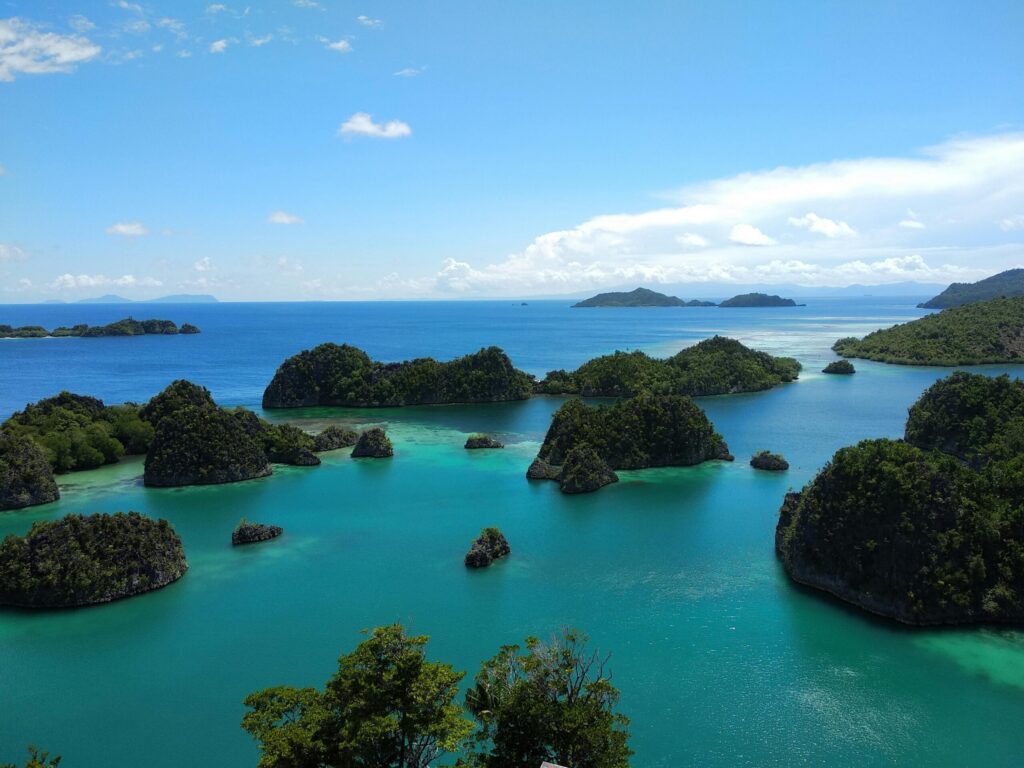
Raja Ampat—literally “the Four Kings”—owes its name to a myth as alive as the mangrove-fringed channels and karst spires that define the archipelago. Local storytellers describe a woman who found a clutch of mysterious eggs in the forest. From these eggs emerged four boys destined to become kings, each presiding over one of the main islands: Waigeo, Salawati, Misool, and Batanta. Other versions add a princess and a spirit, with one egg that never hatched—an object that anchors the story in the tangible world. As you idle by boat through Kabui (often misheard as “Kabuki”) Bay—between Waigeo and Gam—this origin tale feels believable.
The Passage
The bay is a labyrinth of towering limestone pinnacles, secret lagoons, and the famed current-swept channel known as The Passage, where Alfred Russel Wallace once sailed. Villages tucked into mangrove shadows keep the rhythm of adat (customary law), and it’s within this web of belief that an “unhatched” egg is said to have turned to stone. The narrative changes slightly from village to village, but the essence is consistent: the land and sea, the people and their leaders, were born together from the same miraculous source. Many elders tell the story in a cadence that blurs time—the kings are not relics of the past; they are ancestors whose presence continues to protect the reefs and guide the community’s obligations to nature.
The Stone Egg and the Cave of Custodians
Ask carefully and you’ll hear about a sacred limestone cavity near Kabui Bay—sometimes described simply as a keramat (holy) cave—where a petrified, egg-shaped stone is preserved by appointed custodians. The “stone egg” is more than a curiosity; it’s a covenant embodied in mineral form. Villagers say it sleeps in darkness, wrapped and cradled on a natural shelf, visited with offerings of betel nut, sago, and whispered prayer. Access is tightly restricted by adat, both to protect the object and to maintain cosmic order: things of the beginning must not be handled lightly.
On rare occasions—often just once every few years—the egg is brought out for a ceremony that reaffirms community bonds and asks for balance: safe seas, fruitful reefs, harmony between people and place. There are layers of taboo around this: some clans stipulate that only certain elders may touch it; women and men have defined roles; and songs may be chanted to “wake” the egg’s guardians. While the details are not publicized, local guides who work closely with village leaders attest that foreign guests can sometimes be present, but only when formally invited and only on ceremony day. The rest of the time, even well-meaning visitors are politely steered toward Kabui’s scenic highlights—Batu Pensil (Pencil Rock), The Passage drifts, limestone viewpoints—without mention of the cave’s exact location. In a destination famous for open-water panoramas, this deliberate invisibility is part of the story: some treasures are protected by not being made into attractions.
Etiquette, Access, and Practical Logistics for Travelers
If you hope to connect (respectfully) with this strand of living mythology, start in Waisai, the capital of Raja Ampat Regency, reached by ferry from Sorong. Kabui Bay is about 30–45 minutes by longboat from Waisai or Saporkren village, and conditions are generally calm thanks to sheltering karst walls. Work through a reputable local guide or homestay host who has long-standing relationships with nearby villages; they’ll know whether a ceremony is approaching and if guests can request attendance.
Expect to pay two kinds of fees: the Raja Ampat Marine Park permit (available in Sorong or Waisai; confirm current rates and bring cash) and any adat contribution requested by the village. Dress modestly—cover shoulders and knees—and bring a light sarong. On arrival, remove hats and sunglasses, greet elders first, and let your guide lead. Never enter a sacred site without explicit permission; if invited, move slowly, avoid pointing directly at sacred objects (gesture with an open hand or thumb), and keep your voice low. Photography is often restricted or prohibited during ritual moments; when in doubt, don’t shoot. Drones are almost always a firm “no.”
Practicalities matter here: plan around tides for safe docking, and consider the southeast monsoon (rougher seas, typically June–September) versus the calmer months of October–April. Kabui’s narrow channels can run fast with tidal flow; lifejackets are nonnegotiable, and boats should carry spare fuel and a working radio. For a balanced day, pair any cultural visit with nature-based experiences—snorkeling The Passage at slack tide to see soft corals, exploring mangrove-edged lagoons, or climbing a short karst knoll for views—so the journey remains low-impact and the visit to any sacred space, if granted, is your quiet centerpiece rather than a spectacle.
Conclusion
A Living Myth Worth Meeting with Respect The Four Kings legend isn’t a museum piece—it’s a compass by which many Raja Ampat communities still steer. If you’re fortunate enough to be present when the stone egg emerges from its cave, treat the moment as a privilege, not a photo op. Coordinate through trusted local guides, accept that access is rare and not guaranteed, and let the story unfold on local terms. Do that, and Kabui Bay will give you what Raja Ampat offers at its best: clear water and living coral above all, but also the deeper clarity that comes from encountering a place where myth, sea, and people remain inseparable.